
End of life
End-of-life dates to plan for before the end of 2027
Windows Server 2016 on January 12, 2027, PostgreSQL 14, ESXi 8.0, SQL Server 2017: the dates that matter, with sources, and how to get the list for your own estate.

Nothing happens on the day a product goes out of support. The server keeps running, so does the application. What stops is security patching. The next vulnerability published against that OS won’t be fixed. When an auditor or your cyber insurer asks, they expect a list: the machines affected, their version, and the date patching stopped.
If you’re building a 2027 budget, start with the tables below. Some of the products in them went out of support years ago, and the machines are still running.
Every date comes from endoflife.date, a public, community-maintained reference that links back to vendor announcements. The retrieval date is at the bottom of the post. For anything you will sign off on, confirm with the vendor.
What just went by
| Product | What ended | Date |
|---|---|---|
| PostgreSQL 14 | End of support for the major version | November 12, 2026 |
| Windows Server 2022 | Mainstream support (extended support runs to October 14, 2031) | October 13, 2026 |
| Windows Server 2012 and 2012 R2 | Paid Extended Security Updates (ESU) | October 13, 2026 |
| Debian 11 | Long-term support (LTS) | August 31, 2026 |
| SQL Server 2016 | Extended support | July 14, 2026 |
| MySQL 8.0 | End of life | April 30, 2026 |
| Windows 10 22H2 | End of support (desktops; paid ESU until October 10, 2028) | October 14, 2025 |
| VMware ESXi and vCenter 7.0 | End of general support | October 2, 2025 |
Windows Server 2022 leaving mainstream support doesn’t mean losing security updates, which continue for another five years. Feature work stops. Nothing is urgent, and the version now belongs in your refresh plan.
Windows Server 2016 on January 12, 2027
Windows Server 2016 leaves extended support on January 12, 2027. After that, no security updates without an extra contract.
That date matters because Windows Server 2016 is still in a lot of estates, often on domain controllers built in the late 2010s or line-of-business servers nobody dared to migrate. Paid Extended Security Updates (ESU) are listed through January 12, 2030 (endoflife.date, October 29, 2026). If you’re counting on them, check their terms and price with Microsoft before December.
What ends in 2027
| Product | What ends | Date |
|---|---|---|
| Windows Server 2016 | Extended support | January 12, 2027 |
| Ubuntu 22.04 LTS | Standard support, per endoflife.date as of October 29, 2026 (extended maintenance available through Ubuntu Pro) | June 1, 2027 |
| SQL Server 2014 | Paid Extended Security Updates (ESU) | July 12, 2027 |
| VMware ESXi and vCenter 8.0 | End of general support | October 11, 2027 |
| SQL Server 2017 | Extended support | October 12, 2027 |
| SUSE Linux Enterprise Server 12 SP5 | LTSS | October 31, 2027 |
| PostgreSQL 15 | End of support for the major version | November 11, 2027 |
Already out of support, still running
They still turn up in production more often than anyone would like. Windows Server 2012 appears in both tables: unsupported since 2023, it lost its last paid security updates in October 2026. So does SUSE Linux Enterprise Server 12 SP5: out of general support since 2024, it keeps paid LTSS until October 2027.
| Product | What ended | Date |
|---|---|---|
| Windows Server 2012 and 2012 R2 | Extended support (paid ESU until October 13, 2026) | October 10, 2023 |
| Red Hat Enterprise Linux 7 | Maintenance support (paid extended life cycle support available) | June 30, 2024 |
| CentOS 7 | End of life | June 30, 2024 |
| SQL Server 2014 | Extended support | July 9, 2024 |
| SUSE Linux Enterprise Server 12 SP5 | General support (LTSS until October 2027) | October 31, 2024 |
| Oracle Linux 7 | Support (paid extended support available) | December 31, 2024 |
| Ubuntu 20.04 LTS | Standard support (ESM through Ubuntu Pro) | May 31, 2025 |
“End of support” means different things to different vendors
Any list like this one hides a trap. Microsoft has mainstream and extended support. Canonical has standard support and Ubuntu Pro’s expanded maintenance. Red Hat has maintenance phases and a paid extension. SUSE has general support, then LTSS. Debian has regular security support, then community LTS, then commercial extended support.
For a replacement plan, the date that matters is the one after which you stop getting security fixes without buying something extra. Pick that definition once, for the whole estate, and write it at the top of your report. Otherwise two people will read the same table and disagree about what “unsupported” means.
Getting the end-of-life list for your own estate
None of these tables tells you what you actually run. Getting your own list takes reliable versions, matched product names and somewhere to put the unknowns.
Versions come from hypervisor exports (in RVTools, the OS-according-to-VMware-Tools column), Hyper-V inventories, the CMDB and the AWS and Azure consoles. Each has gaps, which is why you cross them.
Product names are their own problem: “Microsoft Windows Server 2016 (64-bit)”, “Windows 2016 Std” and “W2K16” share one lifecycle, and until they’re matched your count is off.
Machines whose version you can’t establish aren’t “fine by default”. Put them on a separate list; it often tells you more than the others.
Uncia’s obsolescence report follows that path. On our demo dataset (a fictitious insurer, 342 machines and hosts, as of October 29, 2026), it finds 44 machines out of support, 32 more leaving support within 365 days, and 20 with no known end-of-support date, kept apart instead of being counted as healthy. Every date links to its source. The report it produces is written without a language model: each sentence points to the fact behind it, and it exports to Word or PDF for a review board.
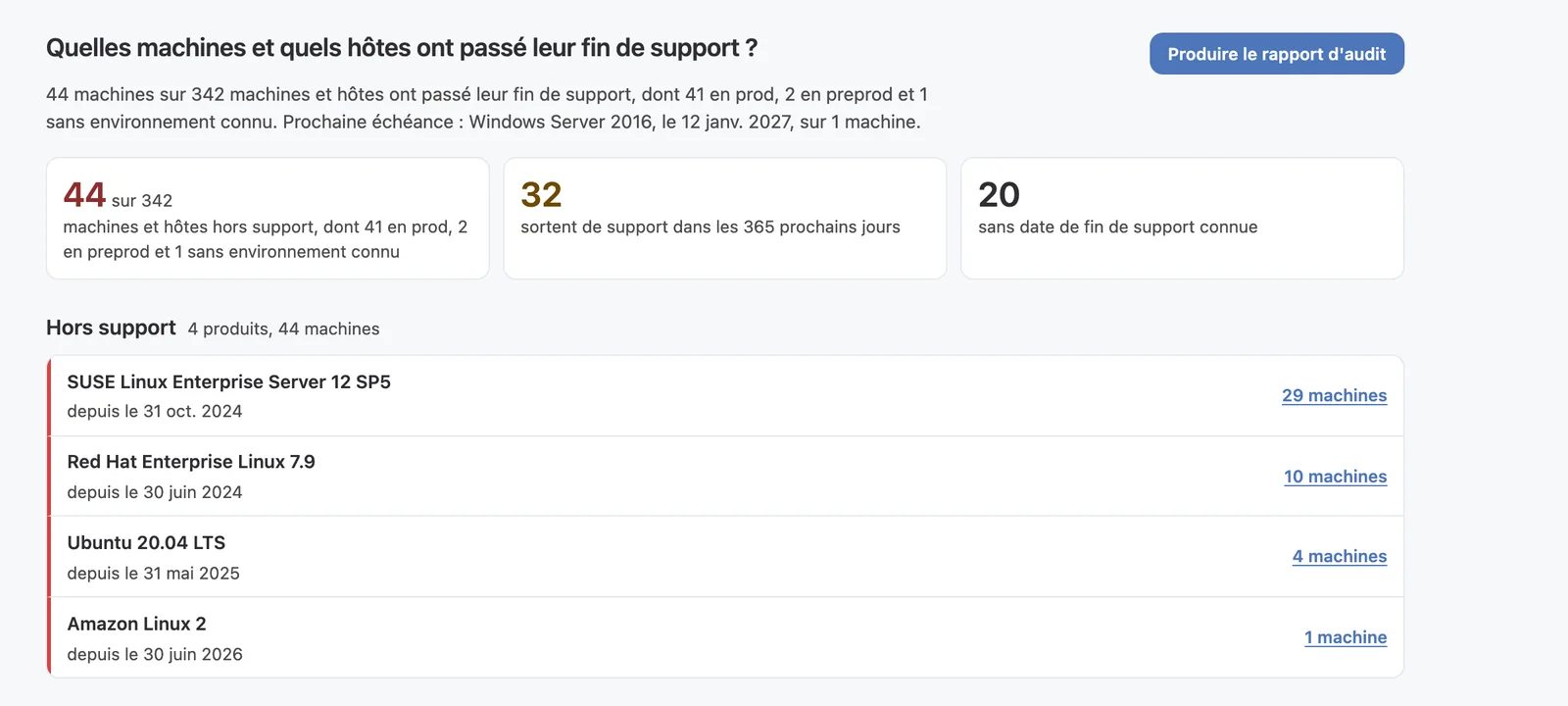
Uncia gives you the dates, the machines affected and the network flows that reach them.
To see the obsolescence report on our demo dataset, book 30 minutes. For details, see end-of-life tracking.
Sources: endoflife.date pages for Windows Server, SQL Server, Windows, Ubuntu, Debian, RHEL, CentOS, Oracle Linux, SUSE Linux Enterprise Server, VMware ESXi, VMware vCenter, PostgreSQL and MySQL, retrieved October 29, 2026.