
Use case · Growing mid-market company
Two estates, 2019 architecture documents, and a NIS2 audit in six months
A 2,000-person company has just absorbed a competitor. Two hypervisors, two CMDBs, two sets of architecture documents, one CISO. The entity is now essential under NIS2, and the risk committee wants a date.
- GLPI
- draw.io
- Word
Figures measured in a demonstration
-
Reading a draw.io diagram
Under 1 second
to read a 2019 draw.io diagram and bring it into the map.
For you: the acquisition's diagrams enter the map without being redrawn.
-
Reading a Word document
About 20 minutes
to read the prose of a Word architecture document on the workstation, without a word leaving it.
For you: the text of your documents stays inside your perimeter; reading runs in the background.
-
Document elements confirmed
90 of 102
proposals drawn from one document and confirmed by the other sources; only one is left to decide.
For you: you only review by hand what is actually in question.
The situation before the NIS2 audit
The head of architecture has a repository for the historical estate, declarative and out of date since the reorganisation. The acquisition comes with 2019 architecture documents, one old draw.io diagram per application and a GLPI CMDB nobody ever reconciled with the hypervisor. The CISO must hand the committee an inventory of assets and dependencies where every row can be defended in front of an auditor, and refuses to let an online AI read the documents.
What gets in the way
- Two sources of truth per layer, neither checked against the other
- Architecture documents where nobody knows which still hold, and on which points
- A NIS2 inventory to produce, every piece of information with its evidence
- A hard constraint: no information may leave the company
What one hour of Uncia brings
Uncia ingests both hypervisor exports, both CMDB extracts, the flow matrices, the firewall rules and the acquisition's architecture documents. Everything is read locally, with nothing sent outside.
- One structure for both estates: sites, clusters, machines, applications, zones
- Every document checked against reality: "the document contradicts itself", "contradicts your sources", gap by gap
- The gaps between each CMDB and its hypervisor, both values kept for a person to decide
- Required flows against rules, with the rule named when it is too broad
- The report in its NIS2 variant, each section tied to its requirement, exported to Word
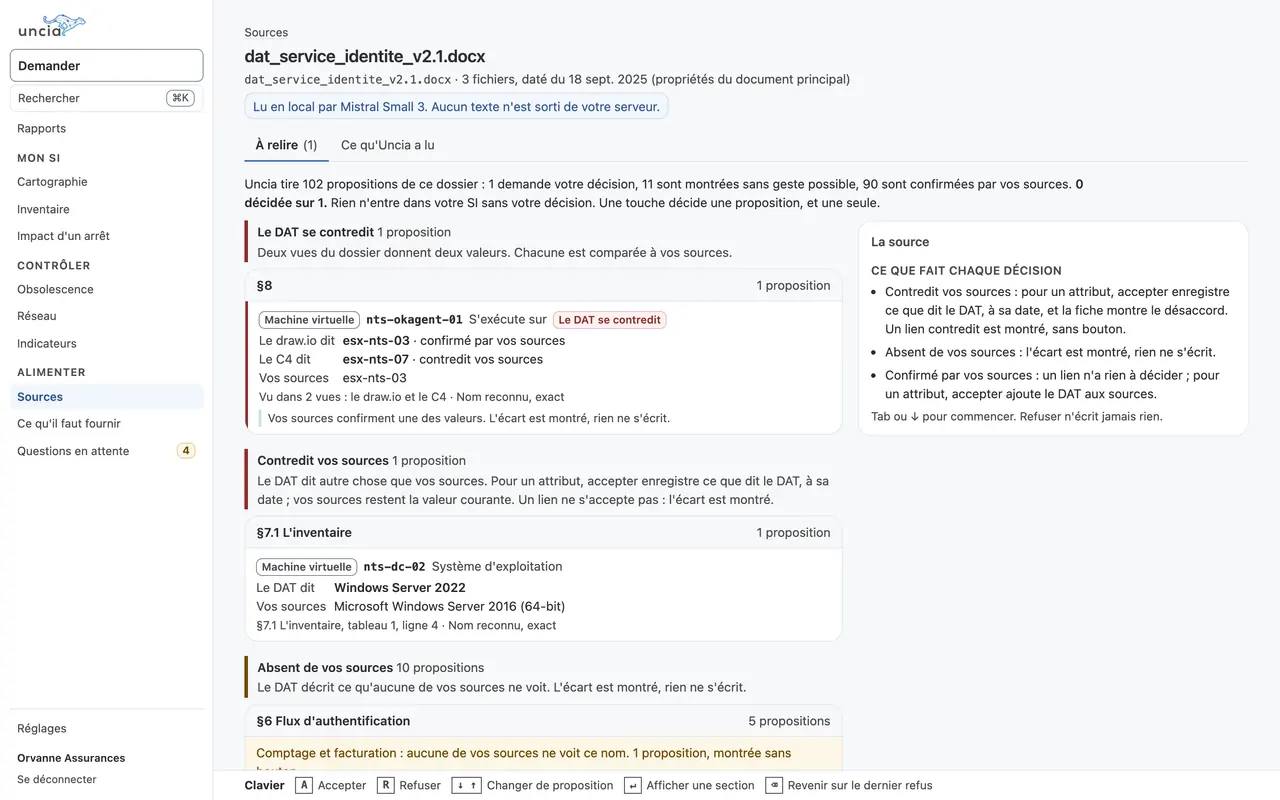
- Located at the paragraph §7.1 Inventory, table 1, row 4
- Contradictions brought forward the document says 2022, your sources 2016
- Uncia does not decide alone gaps are raised for a person to decide
What changes
The CISO brings the committee an inventory where every piece of information is sourced, and a NIS2-structured report that forms the base of the file. The head of architecture knows which documents to update. Nothing was keyed in by hand: the model proposed and the architects accepted or declined, point by point.
-
For the CISO
A file that starts with evidence, and documents that never left the building.
-
For the head of architecture
The gaps between both estates made visible, and a repository that updates automatically with every collection.
-
For leadership
A date that holds, a readable report, an integration run on real information.
See your estate in Uncia in 30 minutes
Bring an architecture document and the hypervisor export it describes. We show you its gaps during the demo.
The features involved
- Feature
Architecture documents
See the feature - Feature
Compliance
See the feature - Feature
Connectors and sources
See the feature