
IT Architecture
Why our language model isn't allowed to write a single fact
In Uncia, the model proposes and a person decides. What that means in practice, what we produce with no model at all, and what the rule costs us.

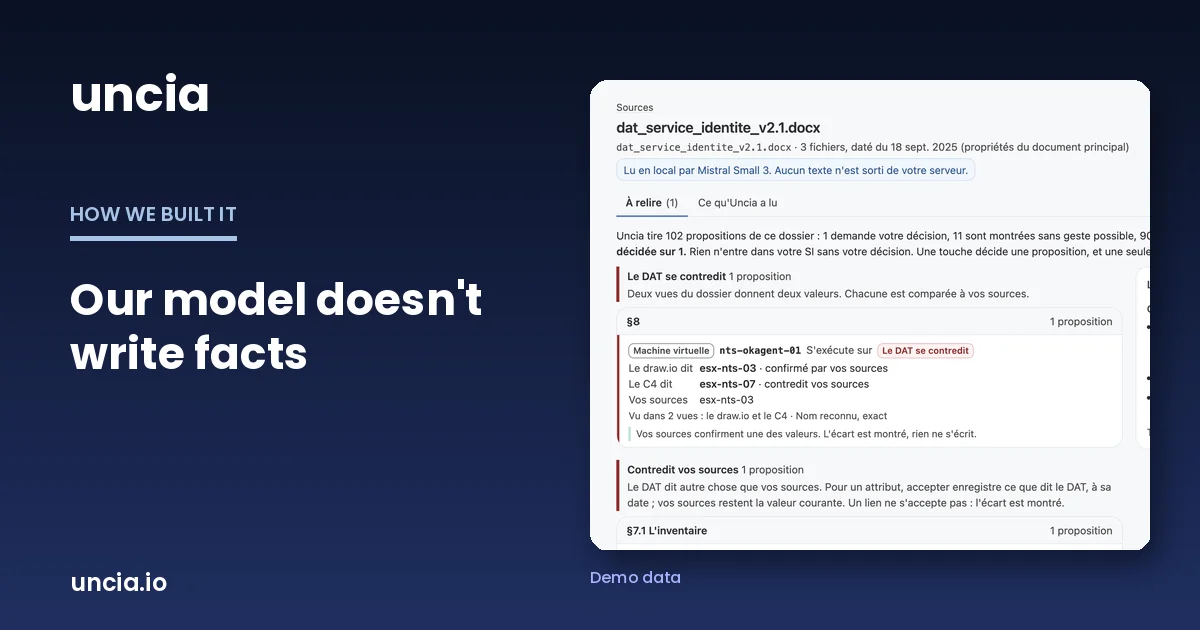
Having a language model read an architecture document makes for an easy demo: hand it a Word document, watch it pull out servers, applications and flows, and see a diagram appear. The demo holds up for about ten minutes, until somebody asks what happens when the model gets it wrong.
While building Uncia we answered that with a rule. Our language model never writes a fact into the repository. It proposes, and a person decides.
The risk we weren’t willing to take
A model reading a document will get things wrong now and then. It reads “srv-app-02” where the table said “srv-app-03”, attaches a flow to the wrong application because two paragraphs sit side by side, or fills a gap with whatever looks likely.
In an architecture repository, that kind of slip becomes a fact. Six months later, during an incident, someone runs an impact analysis whose answer depends on the invented link, and nobody knows it came from an automated read because nothing marks it as different.
A missing dependency leaves a hole in the map, and someone will go and fill it. An invented one looks like every other piece of information in the repository, and nobody will go and check it.
How the rule works
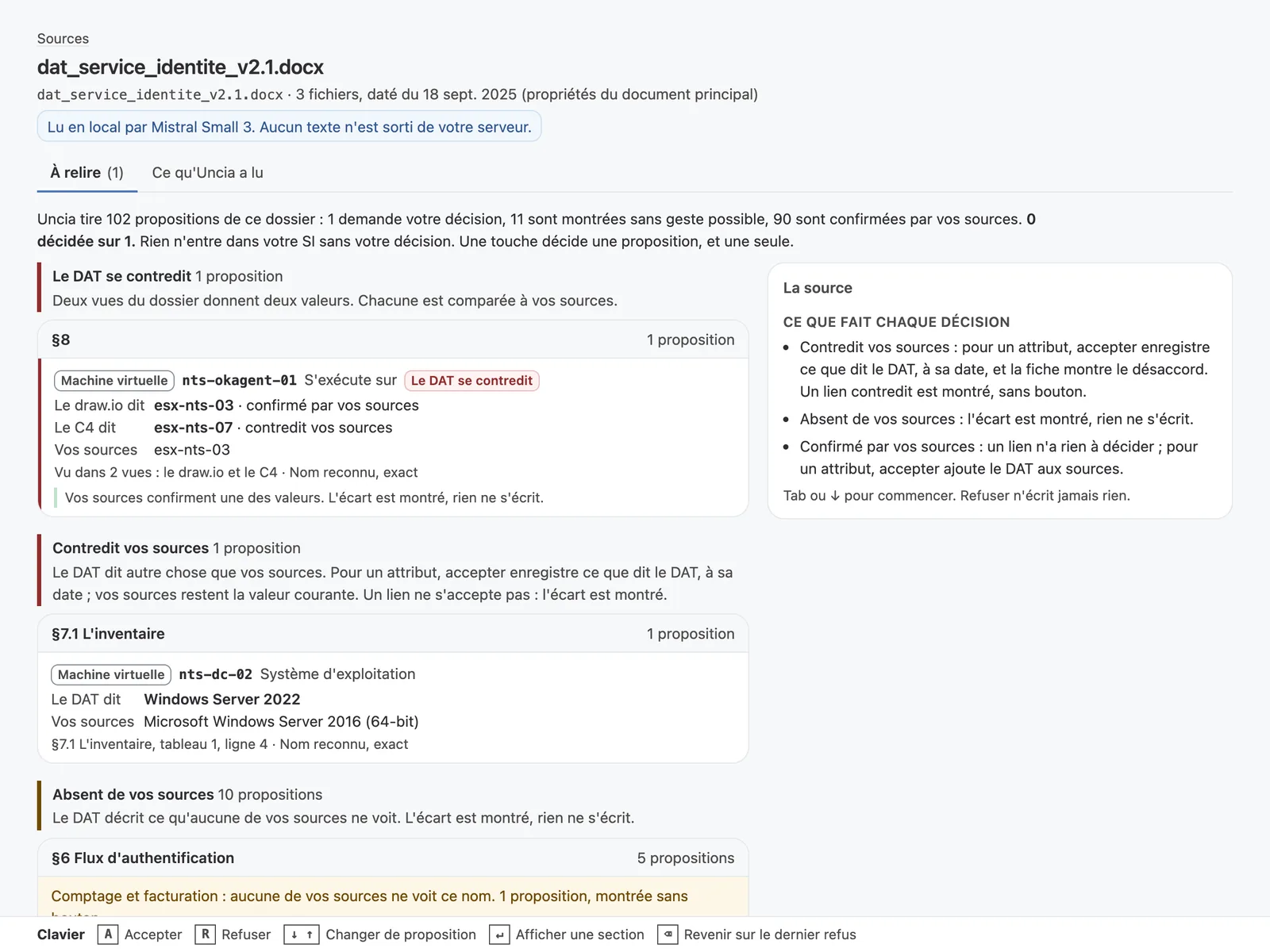
Everything extracted from the document becomes a proposal. Each one shows where it came from (document, section, table, row), what your other sources say about the same thing, and whether they confirm or contradict it.
Nothing is pre-selected. The architect works through the proposals and accepts or rejects each with a single key, and a rejection writes nothing. Accepting an attribute, an OS version for instance, records what the document says as of its date, while your other sources stay the current value. Both are kept, and the gap stays visible.
Some proposals can’t be accepted at all. When the document describes a link your sources contradict, Uncia displays it without a button, so a stray keystroke can’t push a claim the data disproves into the repository.
On a demo document, that sorting leaves very few decisions to make; our piece on architecture documents walks through a full review, gap by gap.
Maps and reports are computed without a language model
Most of what Uncia does involves no language model. The maps (architecture, infrastructure, network, flows between zones) are computed from reconciled facts. The obsolescence report is written without a model, with every sentence pointing to the fact behind it, and the Word, PDF and ArchiMate exports work the same way. draw.io, Visio, ArchiMate and C4 diagrams and the tables in architecture documents are structured files and get parsed as such: in a demo, a diagram from 2019 is read in a fraction of a second. A CISO can therefore have a report produced by Uncia reviewed without looking for sentences written by a model: it only contains facts, each with its source.
When information is missing, Uncia marks it as undetermined instead of guessing. On the first pass it asks at most ten questions, ranked by impact, and a question you’ve answered doesn’t come back.
What’s left for the model, and why it can run on your side
The model reads the prose in architecture documents, the paragraphs where an architect wrote something like “the authentication service relies on the two domain controllers at the main site”. A mid-sized model is enough for that one job. In our demos we use Mistral Small 3, an open-weight model under the Apache 2.0 license, running on the server itself. The review screen displays this line at the top: the text was read locally by Mistral Small 3, and none of it left the server.
A local model doesn’t read as well as a large hosted one, and dense prose still trips it up. The rule exists partly for that reason: when the reading is imperfect, a person needs to stand between the read and the repository.
What the rule costs us
The first cost is time. Reading the prose of one Word document with a local model took around twenty minutes in our demo; a hosted service would be quicker.
The second is the effect in the room. A list of proposals waiting for review is less striking than a map that appears all at once.
The third concerns natural-language questions. They cover closed families: what goes down if something stops, the path of a flow, the machines losing support within the year. The answer comes with sources, and a question outside those families gets no answer.
We accept those costs. On the demo dataset, reviewing a document leaves a single decision to make, and the architect knows where it came from.
To see an architecture document review on our demo dataset, book 30 minutes. What Uncia gets out of your exports is described on the IT mapping page.